The cryptography protecting your network was built for a world without quantum computers. That world is ending on a published schedule, and 2026 is the year planning turns into action. Standards now exist, migration deadlines are set, and attackers are already collecting encrypted traffic to unlock later.
The good news is that this is an engineering project, not a panic. Understanding why quantum safe security matters sets the direction, and a clear checklist turns it into routine work. This guide walks through every step to make your network resilient, in plain language and the right order. Networks are the hardest place to do this work, because keys and certificates spread across firewalls, servers, tunnels and devices that rarely upgrade in step.
Key Takeaways
- Start with a cryptographic inventory: you cannot protect keys and certificates you have not mapped.
- Public-key cryptography is the urgent risk; symmetric encryption only needs larger keys.
- Deploy hybrid key exchange now to defend against harvest-now, decrypt-later collection.
- Federal deadlines deprecate RSA and ECC after 2030 and disallow them after 2035.
- Build crypto-agility so future algorithm swaps are configuration changes, not rebuilds.
What Quantum Safe Means for a Network
Quantum safe security is the practice of replacing algorithms that a large quantum computer could break with ones it cannot. The threat splits cleanly in two, and that split decides your priorities.
Public-key systems such as RSA and elliptic-curve cryptography are the exposed layer. A method called Shor’s algorithm can break them outright, which puts key exchange, certificates and digital signatures at the front of the queue.
Symmetric encryption is far more resilient. Grover’s search trims its strength roughly in half, so AES-256 keeps about 128-bit protection and stays comfortably out of reach. A quick read of blind spots most security teams overlook is a useful reminder that coverage gaps, not weak math, cause most failures.
This is why teams describe the work as a migration rather than a quick patch. Certificates, web servers, VPN tunnels and machine identities all lean on the same vulnerable math, so the fix reaches across many systems at once.
| Why act in 2026
A capable quantum computer does not exist yet, but data stolen today can be decrypted once one arrives. Anything that must stay private past 2030, such as health, financial and legal records, is already exposed unless you move it to quantum safe protection. |
The Deadlines Driving Your 2026 Plan
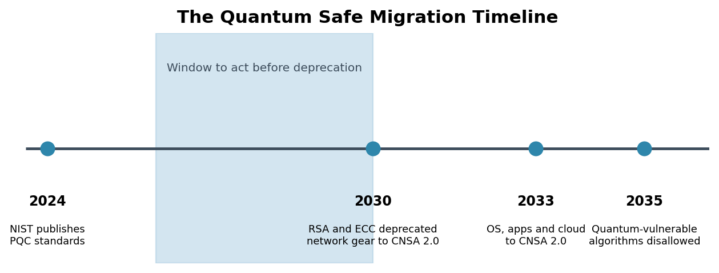
You do not have to guess the timeline, because regulators have written it down. In August 2024 the United States standards institute published the finalized post-quantum cryptography standards, giving vendors concrete algorithms to adopt across networks.
Federal guidance then set the clock. Quantum-vulnerable public-key algorithms are deprecated after 2030 and disallowed after 2035, with security agencies asking network equipment to move sooner. The dates below frame your budget and sequencing.
The pressure reaches beyond one country. The United Kingdom’s national cyber body set a complete migration target of 2035, and the European Union published a coordinated post-quantum roadmap in 2025 that asks critical infrastructure to move first. Wherever you operate, the planning horizon lands in roughly the same place.
| Milestone | Date | What it means for networks |
|---|---|---|
| Post-quantum standards published | 2024 | Approved algorithms ready to deploy now |
| RSA and ECC deprecated | After 2030 | No new use, networking gear expected on new algorithms |
| OS, apps and cloud transition | 2033 | Wider platforms reach exclusive quantum safe use |
| Quantum-vulnerable algorithms disallowed | After 2035 | Full retirement, no risk-acceptance option |
What to Retire and What to Adopt
Most of the work maps onto four cryptographic functions. Knowing the replacement for each one removes the guesswork before you touch a single device. The table pairs each function with its approved successor, so you can brief both your team and your suppliers from a single page.
|
Function |
At risk today |
Quantum safe replacement |
| Key exchange | RSA, ECDH | ML-KEM, or hybrid X25519 with ML-KEM-768 |
| Digital signatures | RSA, ECDSA | ML-DSA, or SLH-DSA for hash-based needs |
| Bulk encryption | AES-128 | AES-256 |
| Hashing | SHA-1, short digests | SHA-384 or SHA-512 |
Hybrid key exchange pairs a classical method with a quantum-safe one, so the connection stays safe unless an attacker breaks both at the same time.
You do not need to switch everything in one move. The recommended path uses hybrid modes during the transition, and widely used libraries already support them. That lets your team gain experience and keep older clients working while the rollout continues.
The Complete Quantum Safe Network Checklist for 2026
Here is the sequence to follow. Each step builds on the last, and most of it strengthens your wider computer security practices along the way.
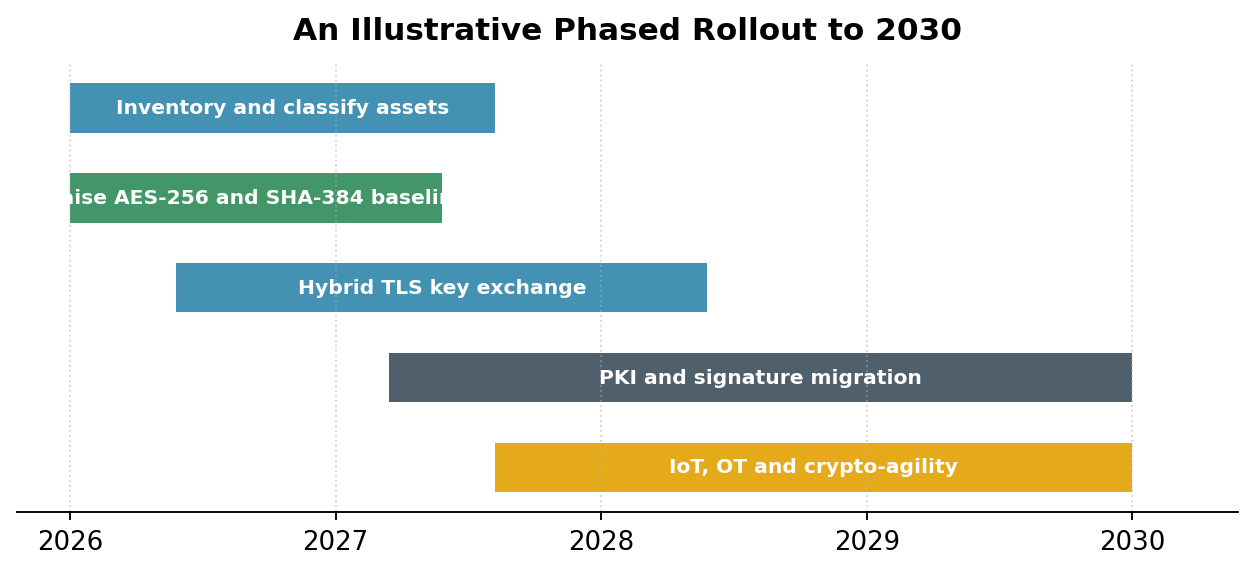
- Build a cryptographic inventory. Map every place keys, certificates and protocols live across servers, core networking fundamentals, applications and suppliers, so nothing hides in a forgotten corner.
- Classify data by lifespan. Rank information by how long it must stay confidential, then protect the longest-lived records first to blunt harvest-now collection.
- Raise your symmetric baseline. Lift bulk encryption to AES-256 while moving hashing to SHA-384 and above, since both enjoy wide support at a negligible performance cost.
- Turn on hybrid key exchange. Enable a classical plus post-quantum handshake on internet-facing TLS services, which protects traffic without breaking older clients.
- Harden VPNs and remote access. Review every tunnel into the network and secure your remote access connections with strong, upgradable encryption and multi-factor sign-in.
- Plan the certificate and PKI migration. Schedule a shift of signatures to the new standards, and confirm your certificate authority can issue quantum safe certificates.
- Cover constrained endpoints. Account for the spread of connected smart devices and operational technology, where limited hardware makes upgrades slower and planning essential.
- Engineer crypto-agility. Build systems that swap algorithms through configuration rather than redevelopment, and write the same expectation into vendor contracts.
| Vendor question to keep handy
Ask every critical supplier which algorithms protect your data, when they will adopt the new algorithms, and how quickly they can change an algorithm if one is weakened. Treat vague answers as a red flag. |
Common Mistakes to Avoid
A handful of predictable errors derail otherwise solid programs, so keep these on your radar from day one.
- Treating AES-256 as the whole answer while leaving key exchange and signatures on vulnerable algorithms.
- Skipping the inventory and migrating blind, which leaves hidden certificates and legacy services exposed.
- Waiting for a forced deadline when long-lived data is already being harvested today.
- Buying point products with no upgrade path, which locks you out of future algorithm changes.
Frequently Asked Questions
Closing the Loop
Quantum safe networking rewards the prepared. The algorithms, the deadlines and the migration paths are all public, so the advantage now goes to teams that inventory early, fix the easy wins, and sequence the rest with intent.
Treat this checklist as a living plan. Run the inventory, set the budget, enable hybrid key exchange, and revisit the roadmap each year as standards and tooling mature. A network you make resilient today is one you will not be scrambling to rescue later.