
Cryptocurrency payments are gradually moving beyond online platforms and entering traditional retail environments. A new point-of-sale solution developed by the company aims to help physical stores accept digital currencies with minimal disruption to their existing checkout systems.
According to an article on Cyprus Mail, CryptoProcessing by CoinsPaid – a major European crypto payment gateway – has launched a closed pilot program designed to bring cryptocurrency payments directly into brick-and-mortar stores. The pilot is currently taking place in Estonia and relies on the technology developed by Flowgate, a provider of POS payment solutions built specifically for accepting cryptocurrency in physical retail locations.
The first merchant participating in the pilot program is Kuldan, an Estonian jewelry brand known for its luxury retail boutiques. The company will test how crypto payments can be integrated into everyday retail transactions while maintaining a smooth customer experience at checkout.
Bringing crypto into everyday retail
While cryptocurrencies have already gained popularity in online commerce, their adoption in physical stores has been slower. Retailers often face challenges such as complex integration processes, unclear settlement mechanisms, and concerns about volatility.
This payment provider aims to address these barriers by providing a payment infrastructure that allows customers to pay with cryptocurrencies while giving merchants flexibility in how they receive the funds. Businesses can choose to settle payments directly in crypto to a wallet or convert them instantly into fiat currency transferred to their bank accounts through SEPA or SWIFT.
This approach allows retailers to experiment with cryptocurrency payments without fundamentally changing their current payment processes. Instead of replacing existing checkout systems, merchants can integrate crypto payments alongside traditional payment methods.

Flexible POS solutions for merchants
One of the key features of the solution is its flexibility. The platform can be deployed in several formats depending on the needs of the business.
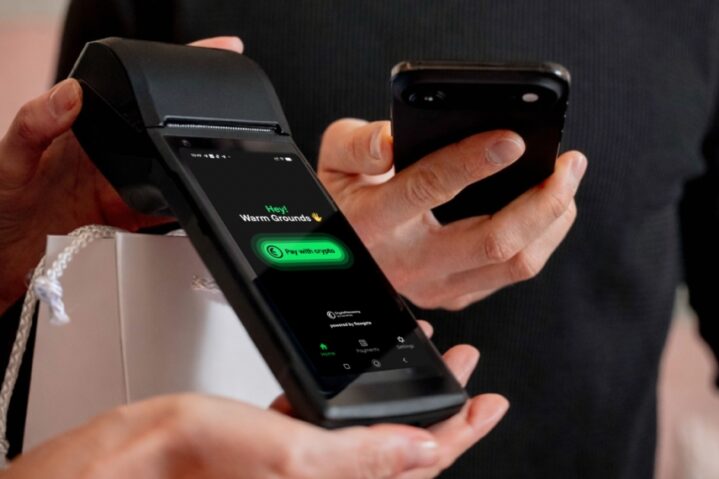
Retailers may use dedicated POS terminals designed to process cryptocurrency payments directly at checkout. Alternatively, merchants can implement SoftPOS technology, which allows smartphones or tablets to function as payment terminals. QR-based payment options are also available, enabling customers to complete transactions using their mobile crypto wallets.
For businesses with more complex infrastructure, API integrations allow cryptocurrency payment capabilities to be embedded directly into existing retail software systems.
This variety of deployment options makes it possible for both small businesses and larger retail chains to adopt crypto payments at their own pace. A single-store pilot can easily scale into a multi-location rollout once the system proves successful.
Lower fees and new customer opportunities
Another advantage highlighted by the company is the cost structure associated with crypto payments. Transaction fees are based on processing volume and are generally lower than many traditional payment methods.
For merchants, the appeal of crypto payments is not limited to transaction costs. Many businesses view digital currencies as an opportunity to attract new customer segments.
“Crypto payments are ready to become a practical retail tool, not just an online feature,” said Vadzim Nikifarau, POS Business Manager at CoinsPaid. “Around 85% of merchants explore crypto as a way to attract new customers and expand their audience.”
According to Nikifarau, the pilot program is an important step toward integrating digital currencies into everyday commerce. By testing the system with early partners, the company hopes to refine the technology and make crypto payments more accessible to businesses worldwide.

Luxury retail leads the way
Historically, luxury retail sectors have often been among the earliest adopters of cryptocurrency payments. High-value goods and international clientele make digital payments particularly attractive for these industries.
Kuldan, the Estonian jewelry brand participating in the pilot, believes that offering crypto payments can enhance the overall shopping experience.
“Our boutiques aim to provide not only exceptional jewelry but also the highest level of convenience for customers,” said Martin Petukhov, General Manager at Kuldan. “Expanding the range of payment options is an important part of that experience.”
Petukhov noted that cryptocurrency payments offer several operational advantages, including fast transactions, the absence of chargebacks, and transparent verification processes.
These features are particularly important in industries where high-value transactions are common and payment security is critical.
Security and regulatory compliance
Security and compliance remain central considerations in the development of crypto payment solutions.
All transactions within the pilot program are processed through their secure gateway, which operates as a licensed provider in Estonia. The company follows strict regulatory standards, including AML (Anti-Money Laundering) and KYC (Know Your Customer) procedures during merchant onboarding.
Additionally, ongoing transaction monitoring and risk scoring help ensure that payments comply with regulatory requirements.
Each transaction processed through the system is final, verified, and traceable, reducing the risks typically associated with chargebacks and payment disputes in traditional card networks.
For retailers, this means greater certainty in transaction settlement and fewer administrative challenges related to payment reversals.

Fast settlements and 24/7 processing
Another feature designed to support retail environments is continuous payment processing.
CoinsPaid offers 24/7 settlements, enabling businesses to receive payments at any time without delays caused by banking hours. This capability is particularly valuable for international businesses and retailers operating across different time zones.
POS terminals used in the system can support multiple cryptocurrencies within a single device, allowing customers to choose from several digital payment options at checkout.
Combined with fast transaction confirmations, this approach helps ensure that the payment experience remains smooth and efficient for both customers and merchants.
The role of Flowgate technology
The pilot program relies heavily on technology developed by Flowgate, a provider of specialized POS solutions for cryptocurrency payments.
Flowgate’s ecosystem includes a variety of tools designed to integrate with existing retail environments. These include physical payment terminals, SoftPOS solutions, QR-based payment systems, and kiosk integrations.
The system is built to connect seamlessly with current checkout software, reducing the need for complex technical upgrades.
Flowgate’s solutions are designed for a wide range of industries, including retail, hospitality, travel, beauty services, and luxury goods. By enabling quick deployment and simplified reconciliation processes, the platform allows merchants to begin accepting crypto payments within days rather than months.
Another important feature is the option for merchants to settle transactions either in cryptocurrency or fiat currency. This flexibility helps businesses manage volatility risks while still benefiting from the advantages of digital payments.
Expanding the global crypto payment ecosystem
The company has already established a strong presence in the digital payment industry. The platform provides infrastructure that allows businesses worldwide to accept cryptocurrency payments securely and efficiently.
To date, the company has processed more than $29 billion in payments and continues to expand its services for global merchants.
By developing solutions that bridge cryptocurrency and traditional retail, the company aims to accelerate mainstream adoption of digital assets as a payment method.
The pilot program in Estonia represents one step in that direction. If successful, similar implementations could expand into other European markets and eventually reach retailers worldwide.
As digital currencies continue to evolve, solutions that simplify their integration into everyday commerce may play a key role in shaping the future of payments.